Have you ever wondered what continent Greenland belongs to? It’s a question frequently asked by geography teachers and world travelers alike.
Greenland is the world’s largest island, and despite its size and seemingly obvious location on our maps, determining which continent Greenland resides in can be confusing – but don’t worry!
This blog post will uncover the ultimate answer to this geographic mystery by exploring its geography, culture, climate, and more.
Read on to find out why, geographically speaking, there is much more than meets the eye when truly understanding where “the green land” lies on our planet.

Is Greenland part of North America or Europe?
Greenland is on the North American continent and belongs to the Kingdom of Denmark.
It has been an autonomous territory since 1979 when the Danish Parliament granted Greenland home rule, which extended in 2009.
Politically speaking, Greenland is closely associated with Europe due to its ties with the Kingdom of Denmark, but geographically, it falls in North America.
So there are two ways to answer the question: politically, Greenland is associated with Europe, and culturally, it is a part of the Nordic countries in Europe, but geographically, it belongs to North America.
Geographically speaking
Greenland sits between the Arctic Ocean and the Atlantic Ocean on the east coast of Canada – about 1,000 km (620 miles) from Iceland.
Greenland is the world’s largest island, with an area of 2,166,086 square km (836,330 sq mi).
Its population is 56,000, making it one of the least densely populated places in the world.
Most of its population is Inuit, with Danish and Greenlandic (Kalaallisut) being its official languages.
Greenland’s climate is mainly tundra, which is cold year-round. However, the island does experience a short summer where temperatures can reach ten °C (50°F).
Where is Greenland located?
Greenland is located between the Arctic Ocean and the Atlantic Ocean on the east coast of North America – just to the north of Canada.
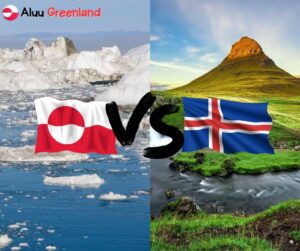
It is separated from Iceland by a narrow strip of water called Denmark Strait, about 800 km (500 mi) wide.
Is Greenland part of a continent?
Yes, Greenland is considered to be part of the North American continent. However, despite its political and cultural ties with Europe, it geographically belongs to a different continent.
Is Greenland one of the seven continents?
No, Greenland is not one of the seven continents. The seven continents are Africa, Antarctica, Asia, Australia, Europe, North America, and South America.
So, while Greenland is a large island with solid ties with Europe and North America, it is still part of the North American continent.
Is Greenland officially a country?
No, Greenland is not officially a country. It is an autonomous territory of the Kingdom of Denmark and falls under the jurisdiction of Danish law, though it has its own government and legislative authority.
Although Denmark gave Greenland home rule in 1979, Greenland is still considered part of Denmark and is not an independent nation.
The fight on Hans Island
One of the few territorial disputes between North America and Europe is over an island between Greenland and Canada in the Kennedy Channel of Nares Strait.
Hans Island was claimed by both Canada and Denmark, leading to diplomatic talks that have not resulted in a resolution.
This is one example of how Greenland’s ties with Europe and North America can be complicated politically.
This little remote island, Hans Island, is just between Canada and Greenland, and because Greenland is part of Denmark, this small island has become a fierce competition between both continents.
Thankfully, it’s not the Middle East, and Denmark and Canada are friendly and open, so finally, on 14 June 2022, both countries decided to split the island in half, resolving this dispute.
Today, Canada–Denmark relations are strong, and both countries peacefully understand their shared interests.
In conclusion
Greenland is the world’s largest island and lies between the Arctic Ocean and the Atlantic Ocean on the east coast of Canada.
Geographically speaking, it is part of North America, though politically and culturally, it has strong ties to Europe.
It is not one of the seven continents and is not officially a country – instead, it is an autonomous territory of the Kingdom of Denmark.
Understanding Greenland’s geography is essential to truly appreciate its unique culture and climate.
Now that you know where this mysterious island belongs on our planet, it’s time to start planning your next adventure!
Who knows, maybe you’ll find yourself exploring the land of the midnight sun.
Anyway, my website is a good source for planning that trip – I’m just saying!